Reading, Writing and Oracy Curriculum
SCHOOL CURRICULUM
1. Regular Diagnostic Assessment
Through English, Literacy and Inclusion, a range of diagnostic assessments are regularly conducted to track student progress and to determine where additional intervention or support is required. The range of assessments, delivered depending on need, include:
- ART -Access Reading Test
- Spelling tests
- Baseline writing tests (school-devised)
- Reading age (comprehension, speed and accuracy) test: NARA- Neale Analysis of Reading Ability (delivered by teachers in person)
- WRAT 5 -Wide Range Achievement Test, 5th Edition – single word reading test
- Regular in-class quality-marked assessments (QMAs)
- GL Assessments (NGRT – New Group Reading Test)
- CTOPP Processing test
- DRA Diagnostic Reading Assessment
- DASH handwriting assessment
- Dyslexia Portfolio
2. English Schemes of Work
All KS3 Schemes of Work in English are all based around specific texts and expanding students’ experience of reading. At KS4, some units are based around specific texts for one of the literature papers, and some are based around a wide range of fiction and non-fiction texts of the type used in language exam papers. Throughout their time at Culcheth, students are explicitly taught a range of reading strategies and encouraged to appreciate great literature and quality writing.
|
UNIT |
Y7 |
Y8 |
Y9 |
Y10 and Y11 (GCSE) |
|
1 |
Tales with a Twist: two Roald Dahl short stories
|
Local Voices, Global Skies: Poetry of Place and People |
‘Crossing the Line’: Crime, Consent and Coercion
|
Shakespeare: Macbeth Priestley: An Inspector Calls Dickens: A Christmas Carol An anthology of poetry 18th – 21st Century A range of modern poetry A range of fiction extracts A range of non-fiction texts |
|
2 |
Mythology: Gods, Monsters and Mortals |
Victorian Literature: Power, Poverty and Protest |
‘Animal Farm’: Rhetoric and Revolution |
|
|
3 |
‘Private Peaceful’: Voices of the Western Front |
Shakespeare’s Julius Caesar: Tyrant or Tragic Hero |
||
|
4 |
Exploring Shakespeare: Romeo and Juliet |
To Kill a Mockingbird: Perspectives on Prejudice |
||
|
5 |
Modern Drama: Noughts and Crosses |
Poetic Detectives: Unlocking Unseen Poetry |
||
|
6 |
Discovering Drama: Shakespeare’s Villains |
N/A |
N/A |
3. English Homework Schedule (Extended Reading)
The English homework schedule covers a range of skills from accurate punctuation and grammar to comprehension and writing skills. At the centre of the English homework schedule is an innovative programme of weekly reading, which includes online texts and video /audio of teachers reading the text, so that students can follow along with the teacher if they wish; it is based on a diverse range of engaging texts. Students’ understanding is tested through regular quizzes set on Google forms through Google Classroom. Running alongside this, there is a programme of pre-reading comprehension to support students with topics explored in lessons. These comprehension homeworks require students to read a wide variety of other texts, ranging through famous speeches, articles, autobiographies, biographical writing, fiction extracts.
|
Y7 |
Y8 |
Y9 |
|
Full texts read |
Full texts read |
Full texts read |
|
‘Five on a Treasure Island’ by Enid Blyton ‘Holes’ by Louis Sachar
|
‘Ghost Boys’ by Jewell Parker Rhodes ‘Patron Saints of Nothing’ by Randy Ribay
|
‘The Hate U Give’ by Angie Thomas ‘The Curious Incident of the Dog in the Night-Time’ by Mark Haddon |
4. Drop Everything and Listen (DEAL)
Every fortnight, all students in Years 7 and 8 ‘Drop Everything and Listen’ as their English teachers act as role models by reading a range of challenging, diverse, engaging and often topical texts, both fiction and non-fiction, to their classes. These texts can be listened to for pleasure, to be informed, to be challenged or to stimulate further debate of discussion.
Examples of ‘DEAL’ texts:
|
‘Tsunami Girl’ by Julian Sedgwick ‘Ready Player One’ by Ernest Cline ‘Terror Kid’ by Benjamin Zephaniah ‘Small Steps’ by Tom Palmer ‘Each Slow Dusk’ by Sheena Wilkinson ‘Penguins’ by Simon James Green |
‘The Outsiders’ by S.E. Hinton ‘1984’ by George Orwell ‘The Hunger Games’ by Suzanne Collins ‘Maze Runner’ by James Dashner ‘Every Man Dies Alone’ by Hans Fallada ‘Looking for JJ’ by Anne Cassidy |
‘War of the Worlds’ by H.G. Wells ‘The Lottery’ by Shirley Jackson ‘The Colour of Humanity’ by Bali Rai ‘The Girl in the Lewandowski Top’ by Tom Palmer ‘The Boxer’ by Nikesh Shukla |
5. ILC Lessons and extra-curricular time
Every fortnight, students in Y7 and Y8 have ILC/Library lessons, where they learn about the Dewey Decimal system of classification, how to effectively use contents pages and indexes to locate information, and how to order books. Each lesson is then based around ‘DEAL’ (see above). Students, of course, have time to change their books to promote a love of reading. There is dedicated reading time too.
The ILC is available at break and lunch times for students to read, change books, order books and study. A love and appreciation of reading is actively encouraged!
6. The Literacy Curriculum
Students are selected to follow the Literacy Curriculum based on careful consideration of KS2 levels, CAT scores, Access Reading Test assessment, baseline assessments and individual educational needs.
The Literacy Curriculum runs through Years 7, 8 and 9. There are approximately 35 students each year who join the programme. Students have two hours of literacy a week in addition to English (three lessons a fortnight in Y9). Literacy Curriculum lessons are heavily staffed with well-qualified teachers and teaching assistants to allow for more individualised support and intervention. There are two Literacy Curriculum pathways in Year 7: Standard Literacy and Intensive Literacy. Intensive Literacy begins with the 30 lessons of the CHS Phonics Programme then continues with the 30 lessons of The Reading Development Programme. When these 60 lessons are complete, students move on to Lexia (see point 20, below). Standard Literacy begins with the 30 Reading Development Programme lessons then moves on to Lexia. Depending on progress through the Lexia programme, Year 9 students have the opportunity to move onto bespoke cross-curricular literacy modules that act as transition to, and preparation for, GCSE study, whilst retaining a sharp literacy focus.
Students’ progress is tracked continuously to inform future teaching.
|
Y7 Standard Literacy |
Y7 Intensive Literacy |
Y8 Standard Literacy |
Y9 Standard Literacy |
|
X4 Lessons per fortnight |
X4 Lessons per fortnight |
X4 Lessons per fortnight |
X3 Lessons per fortnight |
|
Weeks 1-4: Assessment |
Weeks 1-4: Assessment |
Weeks 1-39: Lexia |
Weeks 1-39: Lexia to completion then Personalised Cross-Curricular themed literacy modules (KS3-4 transition) |
|
Weeks 5-19: Reading Development Programme |
Weeks 5-19: Phonics Programme |
||
|
Weeks 20-39: Lexia |
Weeks 20-34: Reading Development Programme |
||
|
|
Weeks 35-39: Lexia |
7. Adaptive Reading Plans, Reading Codes, and Cross Curricular Monitoring of Students Following the Literacy Curriculum
Every student in Culcheth High School sits the Access Reading Test. This gives students a reading age and from that every student is allocated a reading code: green means that students are reading at or above their chronological age; amber means students are up to two years below their chronological age; red that they are between two and four years below; and purple that they are more than four years below. These codes are updated, available on for teachers to see through SIMS, and, where a student has a red or purple code, they are identified on ClassCharts.
For each of the four reading codes, there is an Adaptive Reading Plan. Each adaptive reading plan follows the principles of the CHS adaptive teaching model, the CHS Learning Curriculum, and CHS’s Theories of Action. Each Adaptive Reading Plan contains a range of reading strategies for classroom teachers across every discipline to employ in class to support students reading development, progress and learning. These strategies are evidence based and tailored to need and ability. Staff use the Adaptive Reading Plans to support students throughout the year.
Cross-curricular monitoring, including lesson drop-ins, student voice interviews, staff voice interviews, and work scrutiny will be completed. The purpose is to raise the profile of the students who require additional support with reading or other aspects of literacy, to constantly evolve and improve provision for them, to track what provision is being made to meet their needs across all subjects, and to assess how they are working, all with a view to increasing the level and specificity of support they are offered.
8. KS4 Orange Pathway
Students following the orange options pathway complete the functional skills in English course comprising speaking and listening, reading and writing elements. The course consists of a series of themed units designed to support and develop students’ English development. Students can achieve a gold or a silver award.
9. Literacy Intervention for Pupil Premium Students (Including Y7 Reading Group)
During registration time, students in receipt of Pupil Premium funding are enrolled on a range of English and maths focused interventions to support their progress. At KS3, PP students attend literacy or numeracy based ‘boosters’, which are targeted programmes delivered by specialist teachers. At KS4, PP students attend sessions tailored to improving GCSE performance in English and maths. These sessions are generally delivered by the heads of department for English and Maths or post holders within the departments.
Timetable:
|
|
Monday |
Tuesday |
Wednesday |
Thursday |
Friday |
|
English |
YEAR 10 |
YEAR 7 YEAR 11 RA |
YEAR 8 YEAR 11 RA |
YEAR 9 YEAR 11 |
YEAR 11 |
|
Maths |
YEAR 10 |
YEAR 7 YEAR 11 RA |
YEAR 8 YEAR 11 RA |
YEAR 9 YEAR 11 |
YEAR 11 |
10. After-School Pre-Learning Sessions (for Students with Dyslexia, and Others)
These are hour-long after-school sessions, one for Year 10 and one for Year 11, for selected students with dyslexia, visual stress or other barriers to reading, that run each week. The sessions focus around pre-learning, where students will explore the learning materials soon to be encountered in class, and are approximately two weeks ahead of the English curriculum. Research suggests that this method of pre-learning enables students to process information in the lesson more effectively, increases confidence and reduces frustration. The programme also includes work on skills that benefit students with dyslexia and / or visual stress such as spelling of key words, visual discrimination, and tracking work.
An example from the scheme of work:
|
Week x |
Introduction to A Christmas Carol Outline Exam info Plot summary video Timeline creation |
1. Characters word search 2. Video plot summary (BBC bitesize) 3. Create timeline of plot with summary pictures and outline |
|
Week y |
Plot summary review Historical context |
1.Finish timelines 2. Plot summary quizz 3.Historical context |
|
Week z |
More detailed review of plot Character introduction. |
1. Washing line plot, 1point for correct Stave, 2 points correct position in the stave, minus 1 for in the wrong place. 2. Character match up, who’s who. |
11. Whole-School Oracy CPD, Strategies and Materials (2023-24 and Beyond)
Effective oracy skills are promoted enthusiastically in CHS. In the academic year 2023-24 a suite of research-based teaching and learning materials and classroom tools were introduced to the staff. Through regular whole-staff professional development sessions over the course of the year, these were developed further, refined, and trialled by every teacher in their classrooms. Further professional development time allowed teachers to reflect and share good practice. All teaching staff submitted evidence of how oracy has been used effectively in their classroom and this evidence has been collated and shared in good practice / reflection sessions. The resulting standardised teaching and learning materials are now embedded across the curriculum and regularly reviewed through professional development sessions each year.
12. Whole-School Reading CPD, Strategies and Materials (2024-26 and Beyond)
The whole-school reading project (2024-2026) was focused on developing explicit and effective teaching strategies for the improvement of reading in all subjects in all year groups. In 2024-25, teachers trialled a range of researched-based reading strategies and kept a log of how they were implemented in the classroom. This included evaluation and reflection and culminated in a sharing good practice session that informed the adoption of a range of whole-school reading approaches, enacted that year and beyond.
To supplement this, in 2025-26, all teachers completed the DfE’s Supporting Reading in Secondary School course.
In September 2026, teachers were provided with ‘refresher’ materials on all the above and completed an abridged version of the DfE/FFT Unlocking Reading course.
13. Whole-School Writing Audit (2026-27)
Throughout the academic year, the literacy coordinator will liaise with all heads of department individually in a series of evaluative meetings. A full audit of the pedagogy and resources used in the teaching of writing will be compiled as a report and used to reflect on how the teaching of writing may be further improved. This will be further informed by broad and detailed investigation of existing research with a view to collaboratively improving the teaching of writing in all subjects.
14. Reading Displays
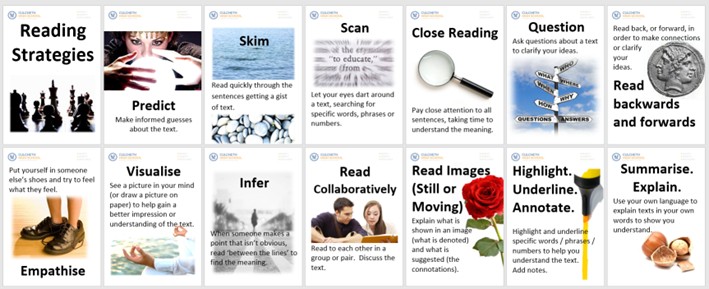
A set of custom-designed posters, originally based key research into classroom reading strategies, then developed in collaboration with all staff, displayed in every single classroom, to promote the consistent teaching of reading strategies across all subjects. The Whole-School Reading CPD programme (above) promotes and supports the effective deployment of these strategies across the curriculum.
15. Peer Reading Sessions (Y10 for Y7)
Once a week, Y7 students who would benefit from some support to increase their confidence with reading are paired up with a Y10 mentor who models good reading for them, listens to them read, helping where required, and asks questions to check comprehension.
16. KS3 Cross-Curricular Reading Anthology – Weekly Reading Homework Programme
Every week. Students in Year 7, Year 8 and Year 9 are set a challenging and enriching text to read for homework. This is followed by a brief quiz. Each week a different subject area sets the texts and the quizzes. Texts are designed to elevate students beyond the curriculum, whilst complimenting it, and enrich students’ experience in a range of disciplines while they broaden and deepen their reading experience.
17. Silver Stories
Wonderfully simple but with an incredibly positive impact for both Silver Listeners and Silver Readers. Children (known as Silver Readers) telephone a Silver Listener every week and then read a short story or poem to them. This not only helps the children to become more confident in their reading skills but also links our children to the older members of our communities and helps diminish their chances of feeling isolated.
18. Reading in English Lessons
Five to ten minutes at the beginning or end of each English lesson is dedicated to reading for pleasure. Students read appropriate books that they have chosen themselves to foster a regular reading-for-pleasure habit and a love for reading. This is logged on their reading tracker located in English exercise books.
19. Reading in Form Time (Y7, 8 and 9)
Once a week, students in Y7, Y8 and Y9 read in form time. Students read books chosen by the English department for their literary merit and cultural capital. Varied reading methods are employed, each with their own advantages in developing students’ confidence in, and engagement with, reading.
20. Lexia
Lexia is a powerful online literacy platform that is regularly cited (by DfE, EEF and FFT, for example) as one of the most effective programmes available to improve students’ literacy. At CHS, students who follow the Literacy Curriculum in Key Stage 3 work on Lexia in their Literacy Curriculum lessons in Years 7, 8 and 9 (see point 6, The Literacy Curriculum, above). Other students with specific literacy needs (relating to SEND, for example) attend the morning intervention sessions. Evidence shows that Lexia accelerates students’ progress in literacy, and, by extension, in other subjects too.
Much more information about Lexia can be found here: https://www.lexiauk.co.uk/
21. Literacy Checklist Stickers
On the front of every exercise book or folder a literacy checklist sticker can be found. These stickers contain nine targets related to effective writing. Students are directed to highlight at least one of the targets in each subject. The highlighting is based on pertinence to writing in that particular subject or student’s focus for improvement. Targets should then be referred to by students when producing writing and by staff when marking.
22. Words of the Lesson
Every lesson, teachers display a minimum of two words for the lesson: at least one ‘academic’ (‘tier 2’) word and at least one ‘subject’ (‘tier 3’) word. These words are explicitly taught as an intrinsic part of the lesson. Substantial evidence shows that explicit vocabulary teaching has a significant impact on students grades and progress as well as better equipping them for all aspects of life after school.



Social Media Posts